A Heart Transplant or just Cosmetic Surgery?

wpid-WhiteWashedCaveTomb.GC11yGv4WeCU.jpgOn Sunday we spent some time looking at what it meant to be “imitators of God” as Ephesians 5:1 instructs, and we considered that if we are to become imitators, it was going to require that a fundamental, core-level transformation take place. Unfortunately, we are too often content to settle for a surface-level behavior modification; if we can just act differently, that will be enough. The problem is that acting differently from what we truly are doesn’t make us imitators, it makes us impostors. Or, to say it another way, we’re happy settling for cosmetic surgery when what we really need is a heart transplant.

The United States (and I’d assume the world, although I cannot speak from experience) is full of people who adhere to an expression of Christianity that is essentially cosmetic surgery. It’s nothing more than behavior modification. And there are two ways that it is most often manifested.

The first is probably the most common way, and it’s the general belief that if a person does more good than bad, they will get into heaven. We can’t be perfect, this crowd suggests, but as long as our good deeds outweigh our bad deeds then on the scale of relativism we are a “good person”; if the scales tip the other way, we are a bad person. Consequently, my bad deeds can be outweighed by my good deeds; they are, in effect, offset. Or, to say it another way, if I modify my behavior I’ll be okay, so long as the good column has more marks than the bad. In this particular worldview, Christianity is essentially boiled down to “being good”, with Jesus being the primary “do-gooder”. He is the supreme example of doing more good than bad (since he did no bad, and a lot of good).

The second expression of behavior modification is just as prevalent, however, and it is no less damaging. This is the belief that our religious activity, done out of obligation, is ultimately the thing that will get us into heaven. It’s the mentality of “I go to church/pray/read my Bible/give because it is the right thing to do”. There is not an internal, core-level motivation to do these things, but a surface level “duty”. It is religion at it’s finest; as long as you are devoted, you are in. You must meet the standard (the “right” way), and when you do, you will be righteous. It doesn’t matter how you actually feel about a person, so long as you act rightly towards them. It doesn’t matter what you think about God, so long as you act rightly by going to church. Your devotion to him will be enough to earn your way into heaven.

At issue is that on the surface both of these expressions of Christianity look good. It seems fair to assume that Christians will be good people, and certainly there is a sense that they will act right according to whatever moral or ethical standard is in place. But that is not the transformation the Bible talks about; and it’s not the kind of transformation that Jesus came to deliver.

Jesus goal was not just to get people to “get their act together”, but to fundamentally change their affections from the temporary to the eternal, from the finite to the infinite, and from the created to the creator. He did that by being an imitator and reconciling man to God through his sacrifice on the cross. When we are dependent on him for our salvation, we are fundamentally transformed on the deepest level from self-glorifiers to God-glorifiers. Our very motivations change, not just our activities. That is the definition of what it means to have a heart transplant. We need to have a change at the core of our being, and that is what Jesus offers.

Most of us, however, will default to the cosmetic surgery. It’s easier. You don’t really need a specialist. It’s often an “out-patient” procedure, it’s over pretty quickly, and you’re probably going to get a lot of compliments when it’s all done. And, as far as medical procedures go, it’s relatively inexpensive. The problem, of course, is that regardless of how good we look on the outside the insides are still falling apart.

At the end of the day, religious cosmetic surgery is the functional equivalent of painting a tomb–no matter how pretty the outside looks, the inside is still full of death (Matthew 23:27).

Read More

Smartphones as Bibles

wpid-Screenshot2010-07-20at1.59.45PM.pKeNovNsugXY.jpgThis past Sunday we invited one of the members of our community, Chris, to read the Scripture before the message. (We hope to continue doing this, since we want to find as many way as possible for people to be involved with the worship service. If you’d like to read at a service, contact Tim McHugh.) You may have noticed that when Chris went up to go and read, he didn’t actually bring a Bible with him. And no, he didn’t have the passage memorized (at least, not the ESV translation). Instead, Chris was using his iPhone as a Bible.

Many people, like Chris, have found that the most convenient Bible to carry around, have on them, and read throughout the day is the one that is installed on their smartphone. In many worshiping communities it has already become commonplace to see people pull out their iPhones, Blackberries, Palm’s, and Android devices to read along with the Scripture as the pastor reads from his text. Although this isn’t anything that’s particularly new–Bible texts have been available on PDA’s for some time–the prevalence of smartphones means that more and more people have access to a digital bible, and consequently, it doesn’t seem as weird for a person to pull out their phone and follow along. It used to be that if you pulled out your PDA in church, people assumed you were playing Tetris. Increasingly, however, the assumption is you’re just reading your Bible.

That’s not to say that we’re all totally comfortable with it yet, though. Maybe we’re okay reading along with the Pastor on our digital bible, but what happens if we receive a text message? What about tweeting in church? And is there a possibility that we might get sidetracked and just take a quick peek at Facebook, or the latest scores on the internet? Wouldn’t it be better to just leave the phone in our pocket and do things the old fashioned way?

Maybe it would be. But the cat’s already out of the bag. (Or, the phone’s already out of the pocket.) And I say, let’s embrace it. Technology will only become more and more a part of our lives. Just because it may require discipline to use it well (like not clicking over to the Facebook app), doesn’t mean that it shouldn’t be used at all. If using a digital bible means that people are using a bible, then I consider that a win. And maybe that random tweet during service piques someone’s curiosity about what we’re doing so that they decide to check it out the next week. You just never know.

So let me invite you to pull out your smartphones and follow along during services. If it’s a distraction, put it away. But don’t let the possibility of it being a distraction stop you from using it for some positive purposes, like reading the Scripture.

If you’re looking for a good app for your phone, LifeChurch.tv has spent significant resources producing what is by far the best Bible Reading app on mobile platforms, and possibly on the web. You can go to www.youversion.com to check out more information and find out if they make an app for your phone. While you’re there, make sure to create an account and join the Restore group at http://www.youversion.com/groups/restore. We look forward to seeing you there!

Read More

The Bible I Use in Church

For the past few weeks I’ve been encouraging (some might say “guilting”) our community to bring their Bibles on Sunday. There are several reasons why I think that bringing a personal Bible to church is a worthwhile practice, but one of the main reasons is accountability. I am not infallible as a preacher, but the Bible is; as a result, my words carry no authority except that which is built on whatever is contained in the text. My opinions carry no special value; God’s opinions are of infinite value.

By bringing your Bibles to church you are able to hold the preacher accountable because you are able to determine for yourself whether or not what he is saying is in line with what the text is plainly teaching. This is what the Bereans were commended for in Acts 17:11. If the Apostles were pleased that their listeners were examining the Scriptures to test the validity of what they were saying, how much more pleased should we be when our community is looking to the Scripture to examine the truth of what is being preached! While there is some value in projecting the words on the screen, it can’t replace your personal Bible–after all, whose to say the projected words haven’t been tampered with? Although it is highly unlikely, the only way to be absolutely certain is to bring your own text. And of course, in so doing, you will have increased your familiarity with the Bible which is likely to lead to a growing relationship with Christ.

In encouraging our community to bring their Bibles, however, I forgot about one minor hitch. Most of the people in our community are using the New International Version (NIV) translation of the Bible, and I have been preaching from the English Standard Version (ESV). Early on I was making special note that my translation might sound different, but in the past few weeks I’ve taken that for granted. Consequently, as people have brought their Bibles, they’ve found it to be more distracting since what I am reading and what is on the screen is different from what they are seeing in the Bible on their lap! (Ironically, this only reinforces the point I’ve made above: without having a Bible, they didn’t even know there was a discrepancy!)

With that in mind, I wanted to address the question of why I use the ESV instead of the NIV. After all, the NIV is a good translation, I own several NIV Bibles, and the Bibles that we hand out on Sunday’s are NIV’s (for now). Wouldn’t it be easier to stick with the known?

In short, yes. It would be easier to stick with the known. The NIV is a great translation that I grew up on and have enjoyed without any reservation for more than two decades. I’m hesitant to say anything that would diminish it’s value, and I certainly wouldn’t be so bold as to say that the ESV is a better translation. Having said that, I think that there are at least two reasons why the ESV is a better fit for our community.

The first reason is the translation technique. The NIV uses what’s referred to as a “dynamic equivalence” translation method. In essence, it is a “thought-for-thought” translation that takes a phrase or sentence from the original language and translates the meaning of the phrase into readable English. The readability of the NIV is what has made it so popular, and it’s relatively conservative translation is what makes it good. It doesn’t go so far as a paraphrase (like The Message), but isn’t as literal as the second type of translation method, called “formal equivalence” (or “literal”). This type of translation is more accurate because it is translating word-for-word; the sacrifice is in the readability (as in the KJV).

The ESV attempts to close this gap between readability and accuracy. It is in the tradition of the “formal equivalence” translation technique and calls itself “essentially literal”. In many cases, you won’t notice much difference between the NIV and the ESV, but sometimes the differences are quite pronounced. Most of the time, it doesn’t change the meaning of a given passage, but it does alter the thrust or the impact. One example of this is Romans 8:36:


ESVFor your sake we are being killed all the day long
NIVFor your sake we face death all day long

It’s a subtle difference, but there is a different type of impact between being “in the face of danger” and actually “being killed”. Especially for a Roman Christian who literally had brothers and sisters being killed all day long. It wasn’t just dangerous to be a Christian; for most people it literally came at the pain of death.

The second reason I prefer the ESV is that it is more true to a reformed theological perspective. This is not to say that the text has been forced into this perspective, but rather that translating more closely word-for-word will yield this perspective in the translation. (The study notes, on the other hand, are pretty clearly from a reformed theological position.) One example of this is in Romans 12:1. Paul has just gotten done highlighting God’s work in salvation and then he turns to the recipients of that salvation in Romans 12.


ESVI appeal to you, therefore, brothers, by the mercies of God, to present your bodies as a living sacrifice…
NIVTherefore, I urge you brothers, in view of God’s mercy, to offer your bodies as living sacrifices…

Again, the difference is subtle, but the emphasis in the ESV is on God’s work in salvation, and the emphasis in the NIV is on our response. The ESV equates the presentation of our bodies with the mercies of God; it’s the only possible outcome of what God has done. In essence, If God has bestowed these mercies of salvation on you, then all that you can do is present your bodies in a worthy manner. There isn’t an alternative. God has so powerfully transformed you that the only outcome is your sacrificial life as a worshiper. The NIV, on the other hand, takes a slightly different tone; the emphasis is on the person who has received the mercies, as if they are now looking back on what God has done and in response they are urged to offer their bodies sacrificially. In other words, now that we’ve considered what God has done (in view of it), isn’t it the right response to offer our bodies this way? Both of these translations (and emphasis) are true. But what I want people to remember is that they are worshipers not because they decided to respond to God in a certain way (although they are responsible to do that) but because God has so powerfully recreated them that the only response is to be a worshiper.

As I’ve come to appreciate the differences between the ESV and the NIV, I’ve come to believe that the ESV is a more beneficial translation for our community, and at some point I hope that all of us begin to make the transition over to it as our standard translation. If you’d like more information on the ESV, you can read more about it at http://www.esv.org. Additionally, they have a page of comparison passages at http://www.esv.org/about/compare.verses.

In the meantime, at least you’ll know why the words in your Bible might not match the words on the screen!

Read More

Ephesians: A New Way of Walking

wpid-Ephesians.kb28RrFawNYw.jpgReplacing the real reason that the church exists with anything else will lead to destruction. Read that sentence aloud, and It will probably sound like an overstatement. The reality, however, is that we cannot overstate how damaging it is when we lose our focus on the glory of God and his gracious activity done in Christ on the cross. It is our very identity that is at stake. If we lose our focus, we lose our identity. It becomes increasingly difficult, and in the end impossible, to differentiate us as a gathering of people from any other gathering of people in the world.

One of the most important things we can do as a gathering community at Restore is to get the first things first and the right things right. It seems like a simple task, but the reality is that when new things are happening and momentum is moving forward it is often easier to get swept up in the excitement than it is to carefully consider the type of community we want to be. It’s easy to lose our focus. Sometimes, the excitement ends up being our goal; the momentum becomes the thing we want to maintain. They become our identity.

That’s why we’re going through the book of Ephesians as our first series together. Paul labors for the first three chapters to carefully remind the Ephesians (and us!) of the glorious work of God on their behalf. He wants to make sure that they (and we) get it right: this whole deal is about the glory of God, acting in love on our behalf, to save us while we were far off, to bring us close to him by Christ’s blood shed for us on the cross, so that we could be adopted into his family, stamped and sealed with the Holy Spirit so that we would know we are his and we have an imperishable inheritance in store. This is God’s story, and he graciously invites us to join Him.

He then goes on in the second half to tell us what that ought to look like in the church. He gives us “a new way of walking”. It’s the way that we walk, act, and live now that we have been saved by Grace, empowered by the Holy Spirit. It’s essential that we understand what that looks like, but it’s also essential that we don’t get it backwards. We must begin with the glory of God and his son Jesus f the second half of the story is going to be possible.

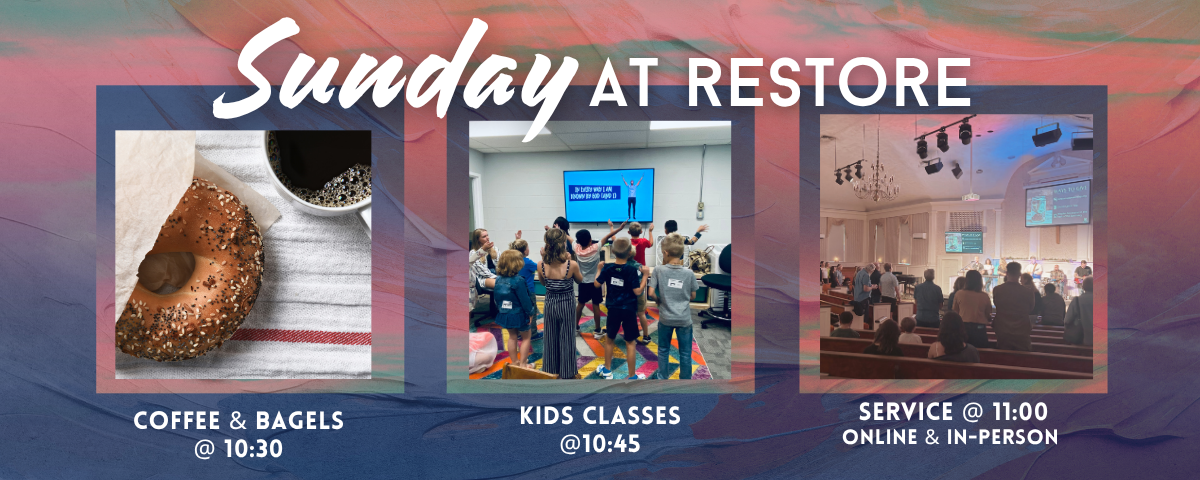
It seems to me that in the modern era one of the great challenges of the evangelical church is that, as was charged to the Ephesians in the book of Revelation, we have “forgotten our first love” (Revelation 2:4). My prayer for us is that, from day one, our focus would not be on flashy graphics, good music, tasty bagels, or casual dress. It wouldn’t be on choirs, buildings, or “the way we’ve always done it”. My hope is that our focus would be on our first love: on Jesus, who died for us so that we might live.

Join us as this Sunday at 10:30 as we continue our series in Ephesians 2:1-10 and consider this “New Way of Walking”.

Read More